

You’ve packed the lead, put the food somewhere obvious and written down the alarm code, then suddenly wonder: have you forgotten something important? Knowing how to prepare for a pet sitter's visit can make the handover feel much calmer, for you and your dog.
It’s natural to worry that a small but important detail might slip your mind, especially when your dog has a familiar routine or particular needs. Clear, practical instructions help your sitter understand what your dog is used to and how you’d like things done, so the visit can begin with reassurance rather than guesswork.
This checklist will help you get your home ready, explain your dog’s daily routine and share useful care information, from meals and walks to behaviour and comfort. We’ll also cover access arrangements, emergency contacts and how you’d like to keep in touch. At Jolly Dog Walks, our meet-and-greet checklist brings these details together, because a thoughtful handover is an important part of caring for your dog.
Key Takeaways
- Use a simple checklist to organise your dog’s care details, home access, emergency contacts and communication preferences.
- Write clear, accurate instructions about your dog’s routine, needs and behaviour rather than relying on a sitter to guess.
- Separate what to leave ready at home from arrangements that are best discussed before the visit.
- Learning how to prepare for a pet sitter's visit can help you make the handover calmer and more reassuring for everyone.
- Keep essentials and written instructions together so the sitter can find what they need easily.
How to prepare for a pet sitter’s visit: start with your dog’s routine
Leaving your beloved dog with someone new can feel like a big step, even if it’s only for a short visit. A little preparation can make the handover clearer and help your caregiver understand what your dog is used to. If you’re wondering how to prepare for a pet sitter's visit, start with the everyday details: familiar routines, your dog’s needs, home access, emergency contacts and how you’d like to communicate.
Care can vary depending on the arrangement, as the general overview of pet sitting explains. Whatever the visit involves, accurate information helps your sitter follow your preferences rather than having to guess. It can support a smoother start, but every dog responds differently to a new person or change in routine, so preparation can’t guarantee how your dog will feel.
Write down the dog’s everyday routine
Think through a typical day and note what happens, when it usually happens and what helps your dog settle. The aim isn’t to schedule every minute. It’s to share the rhythms that make the day feel familiar, along with enough detail for the sitter to follow them as closely as possible.
- Meals and rest: Note usual meal times, portions and any feeding instructions, as well as when your dog tends to nap or prefer a quiet spot.
- Toilet breaks and play: Explain your dog’s usual bathroom habits, favourite games and how they show they need to go outside.
- Exercise and cues: Describe your dog’s exercise needs, preferred routes and typical walking distance. Include familiar commands and what your dog usually does in response, such as coming back when called or waiting at a doorway.
Be specific where it helps. “A short, quiet walk suits her better than a busy route” gives a clearer picture than “likes walks”. If a routine changes on certain days, mention that too.
Share the details that help the caregiver understand your dog
Basic details are useful for identifying your dog and understanding their needs. Add their name, breed, age, gender and weight, then describe their personality in everyday language. Include what they enjoy, what worries them and how they tend to behave around unfamiliar people or other animals.
- Temperament and social experiences: Describe specific fears, triggers or situations your dog finds difficult. For example, explain if traffic, sudden noises or close greetings make them uneasy, and what helps them feel more comfortable.
- Health and food: Share relevant health history, allergies, medications and dietary needs. Write medication instructions clearly, including any details your sitter needs to follow, and note foods your dog must avoid.
- Individual preferences: Mention small but useful things, such as where your dog likes to rest or whether they prefer space while eating. These details help the caregiver understand your expectations as well as your dog’s needs.
Keep the notes honest and straightforward. Clear information gives your sitter a better starting point for caring for your dog in a familiar, considerate way.
What information should you give a pet sitter before the visit?
A sitter can’t reliably guess what your dog needs from watching them for a few minutes. Share accurate, practical details before care begins, and update them if your dog’s health or behaviour has changed since you last spoke. A brief, clear handover is more useful than a long page of notes where the most important point is hiding halfway down.
Use plain language and divide your notes into two parts: essential care information the sitter needs to follow, and helpful preferences that make the visit more familiar. For example, your dog’s medication instructions are essential; their fondness for a particular toy may be a useful extra. If you’re considering how to prepare for a pet sitter's visit, aim for notes that someone can scan quickly and understand without needing to interpret shorthand.
Prepare health, feeding and behaviour notes
Keep key health and care instructions together, with any changes clearly marked. Include relevant medical history, current health issues, allergies and medication needs. For each medication, write the instructions you’ve been given and explain how your dog usually takes it. Don’t rely on a familiar routine to fill in a detail that could affect their care.
Give feeding requirements in practical terms: what your dog eats, how much, when, and whether there are dietary needs or foods to avoid. Then explain behaviour in a way that helps the sitter respond calmly and kindly. Describe fears, anxiety triggers and situations your dog finds difficult, alongside the strategies you use to help them feel safe. For instance, if your dog is uneasy around unfamiliar dogs, explain what distance helps and what you usually do on walks. Mention any new or changed behaviour before the visit, rather than hoping it won’t come up.
Make contacts and communication expectations easy to find
Put contact details near the top of the notes, where they’re easy to find in a hurry. Include your own number, your veterinarian’s details and a backup contact who knows your dog. Explain who you’d like the sitter to contact if they can’t reach you, and share any instructions about when you’d like to be called.
Be clear about updates, too. Say whether you’d like a message, photos or another agreed form of communication, and roughly when you’d prefer to hear from the sitter. This avoids uncertainty at both ends: you’re not left wondering how things are going, and the caregiver knows what you expect.
Add small practical instructions that might otherwise be overlooked. These could include a familiar command, where your dog’s water is kept, an activity they enjoy or anything that helps them settle. A useful handover might read: “Milo eats his usual food in the kitchen, finds busy pavements stressful, and settles with his blanket; call me on [number], use the side door with the key safe, and text after the visit.” Keep essential details accurate and preferences clearly labelled.
Jolly Dog Walks’ meet-and-greet checklist brings together care and behaviour information, contacts, access instructions and communication preferences. A thoughtful handover helps make expectations clear for everyone; Jolly Dog Walks’ pet-care visits start with understanding those individual details.
How to prepare your home and compare care arrangements
Some details can simply be left ready at home; others are best agreed with your sitter before the visit. Separating the two helps avoid last-minute confusion, especially around entry, safety and what kind of care your dog needs. This is a practical part of how to prepare for a pet sitter's visit: make the home easy to navigate, then talk through anything that affects the visit plan.
Prepare clear home-access instructions
Write down the full address, the agreed way to enter and any relevant security instructions. If there’s a key safe, explain where it is and how the access details will be shared securely. If the sitter will use a key, agree how they’ll receive it and return it. Explain any alarm steps plainly, including what to do if the system doesn’t behave as expected.
Point out rooms or areas your dog and the sitter shouldn’t enter, and say why. Perhaps a room contains something fragile, or a gate needs to stay shut to keep your dog away from a particular area. Mention home and neighbourhood safety concerns during the handover, too, such as a stiff garden gate, a slippery step or a busy road just outside. It’s much easier to plan around these things when they’re known in advance.
Match the visit plan to the care your dog needs
Use your dog’s routine and exercise needs to talk through what the visit should involve. Explain whether your dog is used to a walk or would be more comfortable with a quieter visit at home. Discuss preferred routes, pace and walking distance, along with which lead or harness to use and how it fits. Share any special handling instructions before the visit, rather than leaving the sitter to work them out at the door.
Puppies may need a different rhythm from adult dogs, including regular toilet opportunities, rest and age-appropriate activity. For more on preparing for a puppy’s home visit, see professional puppy care in Burton upon Trent.
Topic | What to prepare at home | What to explain beforehand
Entry: Leave agreed keys or access instructions ready | Confirm the entry method, alarm steps and how access details will be shared.
Home safety: Make restricted areas clear, with gates or doors in the intended position | Flag hazards, security concerns and areas the sitter shouldn’t enter.
Visit plan: Set out the agreed lead or harness and any essentials | Talk through whether the visit includes a walk or home-based care, plus your dog’s pace, route and specific needs.
Puppy care: Make the usual puppy essentials easy to locate | Explain the puppy’s toilet, rest and activity routine so the visit can follow familiar patterns.
Keep the arrangements realistic and specific to your dog. A clear conversation about access and the visit itself gives the caregiver a much better chance of following your preferences, while helping you feel ready to hand over the front door and your dog’s care.
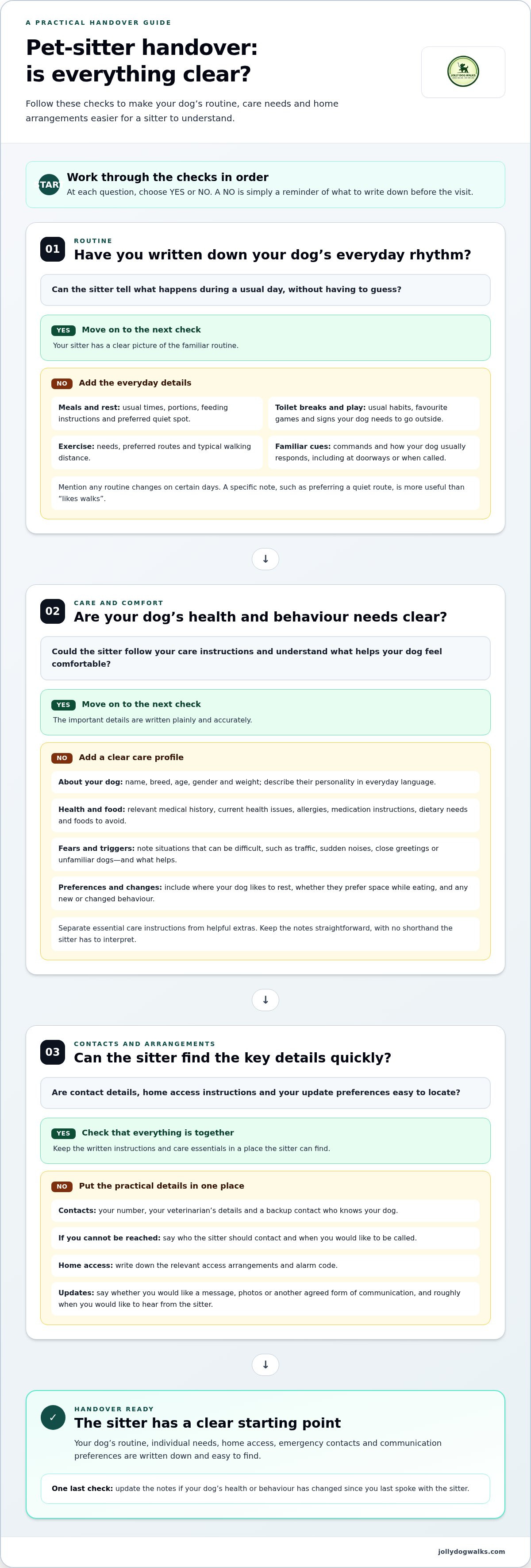
What to do on the day of a pet sitter’s visit
Even with good planning, the day itself can feel a little busy. A short, ordered check helps you leave the important things ready without trying to remember every detail as you’re heading out. Keep your dog’s essentials and written instructions together in one easy-to-find spot, then take a moment for a calm handover.
Set out the essentials and confirm the plan
Before the caregiver arrives, follow this simple checklist:
- Gather your dog’s essentials. Set out their usual food and any relevant care items needed for the visit, such as their lead, harness or familiar toy. Keep items together so there’s no need to rummage through cupboards.
- Put the written routine somewhere visible. Leave the care notes in the agreed place, with emergency and veterinary contact details easy to find. Make sure the information is current and legible.
- Check access arrangements. Confirm the agreed entry method and make sure any key or access details are ready to be shared as planned. Check that doors or gates are positioned as discussed.
- Review the visit expectations. Be clear on what the visit includes and point out any restricted areas or home safety details the caregiver needs to remember.
A designated spot near the entrance or wherever you’ve agreed to leave the notes can make the handover much simpler. Avoid leaving important instructions somewhere your dog might investigate first. Curious noses are excellent at finding paper.
Keep the handover clear and reassuring
If it suits your dog, introduce them to the caregiver in a calm, unhurried way. Let your dog approach at their own pace rather than expecting an instant hello. A friendly greeting is lovely, but some dogs need a little time and space to feel comfortable with a new person.
Before you leave, mention anything that has changed since you shared your notes. This could be a change in appetite, health, behaviour or routine, or something unusual that happened that morning. Keep it straightforward: “She ate less than usual today” is more useful than hoping the sitter notices. If the change affects your dog’s care, explain what you’d like the caregiver to do and how to reach you if they have concerns.
Once you’ve shared the update, give your dog a calm goodbye and follow the agreed plan. Lingering while feeling worried can make the moment more confusing, so aim for a warm, settled handover without rushing or making a big performance of leaving.
For home-based care in Barton, pet drop-in visits in Barton are one option to explore. If you’d like to arrange a visit that takes your dog’s routine and home instructions into account, get in touch with Jolly Dog Walks.
How Jolly Dog Walks prepares for a pet-care visit
Every dog has their own little ways, from the route they enjoy to the things that help them settle. That’s why preparing for a visit is a conversation, not just a key handover. The details you share help build a clear picture of your dog’s routine, your expectations and the practical arrangements at home.
Use the meet-and-greet to build a clear care picture
At Jolly Dog Walks, the meet-and-greet checklist brings important information together before care begins. It covers your dog’s routine and care needs, relevant health and behaviour details, home access instructions, emergency contacts and your communication preferences. Sharing these points gives the caregiver useful context and makes it easier to understand what matters to you.
It’s also a chance to explain the practical details that can be hard to capture in a quick note. Talk through how to enter, any areas that are out of bounds, and safety concerns around the home or nearby. Make sure the owner’s contact details and emergency contact information are clear, and explain how you’d prefer to receive updates. Would a short message be helpful? Are photos welcome? Agreeing this beforehand means everyone knows what to expect.
Bring your own questions, too. You might want to clarify how your dog responds to a particular cue or what to do if their usual routine changes. A thoughtful handover lets both sides share useful information, rather than leaving small but important details to chance.
Take the next step with confidence
Before the visit, gather your notes on your dog’s routine, care and behaviour, along with contact details and home access instructions. Keep them somewhere easy to find, and mention any changes since the meet-and-greet. This simple preparation can help the caregiver understand your preferences and begin with a clearer picture of your dog’s needs. It can’t determine how your dog will respond, but it does give the handover a helpful, considered starting point.
For local owners, Jolly Dog Walks supports dog families around Barton-under-Needwood with a caring, professional approach informed by IMDT training. If you’re still working out how to prepare for a pet sitter's visit, use the checklist in this article as a prompt for your conversation: routines, dog information, access, contacts and updates.
Explore local dog-walking and pet-care information for Barton-under-Needwood, and take the next step towards arranging care that starts with understanding your dog.
Make the handover your dog’s familiar starting point
Preparing well isn’t about making every moment predictable. It’s about giving your caregiver a thoughtful starting point, then allowing your dog time to respond in their own way. A clear handover can turn your notes into a useful picture of the care you’d like your dog to receive.
Jolly Dog Walks’ meet-and-greet checklist brings together care routines, dog information, home access, emergency contacts and communication preferences, helping keep the important details in view. As you consider how to prepare for a pet sitter's visit, think of the handover as the beginning of a shared understanding, not just a list to complete.
If you’re ready to explore local support, take a look at local dog walking and pet-care support. With clear notes and a caring conversation, you can take this next step with greater confidence, while keeping your dog’s individual needs at the heart of the plan.
Frequently Asked Questions
What should I tell a pet sitter before their first visit?
Explain your dog’s everyday needs, what helps them feel comfortable and any boundaries the sitter should respect. Share details that might not be obvious, such as whether your dog needs space while resting or tends to pick up things on walks. A quick written note can help you work out how to prepare for a pet sitter's visit, especially if you’re juggling several details. Invite the sitter to ask questions rather than leaving anything open to guesswork.
How should I prepare my home for a pet sitter?
Make the areas your dog will use easy to navigate, and put away anything they could chew, swallow or knock over. Check that doors, windows and garden gates are secure, and leave lights or heating settings as you’ve agreed with the sitter. If your dog is likely to greet the visitor at the door, decide where they’ll wait so the arrival feels settled rather than chaotic. Keep personal or confidential paperwork out of sight.
Should I arrange a meet-and-greet before a pet sitter visits?
Yes, a meet-and-greet gives you and the caregiver a chance to discuss the arrangement and see how your dog responds in a familiar setting. Keep the first interaction relaxed, without asking your dog to greet or be handled before they’re ready. Jolly Dog Walks provides local dog walking and pet care in Barton-under-Needwood, Drakelow, Staffordshire, Yoxall, Hamstall Ridware, Branston, Burton upon Trent, Tatenhill, Rosliston, Walton upon Trent, Tutbury, Stretton and East Staffordshire.
What should I leave out for a pet sitter?
Leave out only what’s relevant to the agreed visit, such as your dog’s lead, harness, food portions, water bowl and a familiar toy. If your dog needs a towel after going outside, make it easy to find. Keep potentially harmful household products, medicines and small objects safely stored away. Check that any food or care item you leave is clearly identifiable, so the sitter won’t have to guess which one your dog should have.
What if my dog is nervous around a new pet sitter?
Tell the sitter what your dog’s nervousness looks like, such as hiding, barking or avoiding eye contact, and what usually helps. Ask them to stay calm and give your dog room to approach in their own time; don’t insist on a greeting or reach into a hiding place. A familiar bed or blanket can offer a comforting place to retreat. If your dog seems increasingly distressed, discuss a gentler introduction plan before the visit.
What details should I provide about my dog’s health?
Share relevant diagnoses or ongoing health concerns, allergies, medication needs and any signs that mean your dog is not feeling their usual self. Mention changes in mobility, energy or appetite, as these can affect what feels comfortable during a visit. Include your veterinarian’s contact details and explain any care instructions you’ve received from them. Keep information current, and tell the sitter if something changes after you’ve prepared your notes.
How can I prepare a puppy for a pet sitter’s visit?
Give the sitter a realistic picture of your puppy’s day, including how they settle after activity, where they’re learning to toilet and what they’re allowed to chew. Put suitable toys within reach and move tempting cables or small objects out of the way. Keep interactions gentle and reward calm behaviour with praise or a treat if that’s part of your puppy’s routine. Short, positive introductions can help a puppy become more familiar with a new caregiver over time.
Article by
Victoria Cartwright
Hi, I’m Victoria, the proud owner of Jolly Dog Walks 🐾🐶
With a background in nursing and healthcare, alongside my professional training with the Institute of Modern Dog Trainers, I bring a unique combination of care, communication and understanding to my work with dogs and their owners. After leaving my nursing career, I found my true passion in working with animals, and I’ve never looked back!
❤️🐾
Disclaimer
Disclaimer: The views and experiences shared in this blog are based on my personal and professional experiences. They are intended for general information and enjoyment and should not replace individual advice from a qualified veterinary professional or appropriately qualified canine behaviourist/trainer where necessary.


