

Could a roomy hutch, a bowl of pellets and a daily cuddle still leave a rabbit without what it needs? Rabbits have more complex welfare needs than their quiet reputation suggests. Good pet care for rabbits Staffordshire owners can feel confident about starts with looking beyond the basics.
If you’re unsure how much space to provide, what belongs in the food bowl or how to plan care when you’re away, you’re not alone. Rabbits need room to move, suitable companionship, a fibre-rich diet and a steady daily routine.
This practical guide covers housing, food, companionship, everyday health checks and planning ahead. Use it to make thoughtful choices for your rabbits and your Staffordshire home, and adapt the advice to each rabbit’s needs.
Key Takeaways
- Build a daily checklist around your rabbit’s individual needs, so essential care is easier to organise and maintain.
- Make your home safer by checking for household hazards and creating a secure space for normal movement.
- Notice changes in eating, drinking or behaviour, and keep useful information ready for your vet.
- Compare care arrangements by considering routine, supervision and whether your rabbit can stay in familiar surroundings.
- Use this guide to shape practical pet care for rabbits Staffordshire households can adapt to their home and their rabbit.
What does good rabbit care involve in Staffordshire?
Good rabbit care takes consistent daily attention. A hutch alone isn’t enough. Rabbits need a suitable living space, companionship, appropriate food and water, opportunities to move and explore, and regular observation. These needs work together: a dependable routine makes it easier to notice changes and respond thoughtfully.
Welfare-centred rabbit care means meeting a rabbit’s physical and social needs every day, in a safe environment that supports normal behaviour and good health. For owners in Staffordshire, that means adapting care to the rabbit as an individual rather than relying on a one-size-fits-all checklist. The Domestic Rabbit Care overview offers broader background on rabbits and their needs.
Here’s a video about one approach to rabbit keeping and preventative care. Treat it as one perspective, and consider whether its ideas suit your rabbits and their setup.
Which everyday needs should rabbit owners plan for?
Plan for reliable access to suitable food and clean water, a secure place to rest, and enough space to move freely. Rabbits are social animals, so companionship matters too. Welfare guidance generally favours compatible rabbit companions, with introductions and health considerations handled carefully. Safe opportunities to explore, chew and interact help make their environment more engaging.
Feeding, cleaning and checking in are important parts of care, but they aren’t the whole picture. Rabbits also need opportunities to express natural behaviours in a calm, safe setting. Think through how each need is met across the day, including when the household is busy or plans change.
Why does a rabbit’s individual routine matter?
Age, health, temperament and familiar habits can affect what’s normal for a rabbit and what support it needs. One rabbit may be confident and curious; another may prefer a quieter approach. Keep simple notes on usual eating, drinking, droppings, movement and behaviour. These observations give you useful details to share with a vet if you’re concerned.
A change in your rabbit’s usual routine can be an early sign that something needs attention. Notice differences rather than dismissing them as fussiness, especially if your rabbit seems unwell or stops eating. Seek prompt advice from a rabbit-savvy veterinary professional when you have health concerns. Good pet care for rabbits Staffordshire owners can sustain starts with knowing what’s normal for their own animals and acting calmly when it isn’t.
How should you set up a rabbit-friendly home?
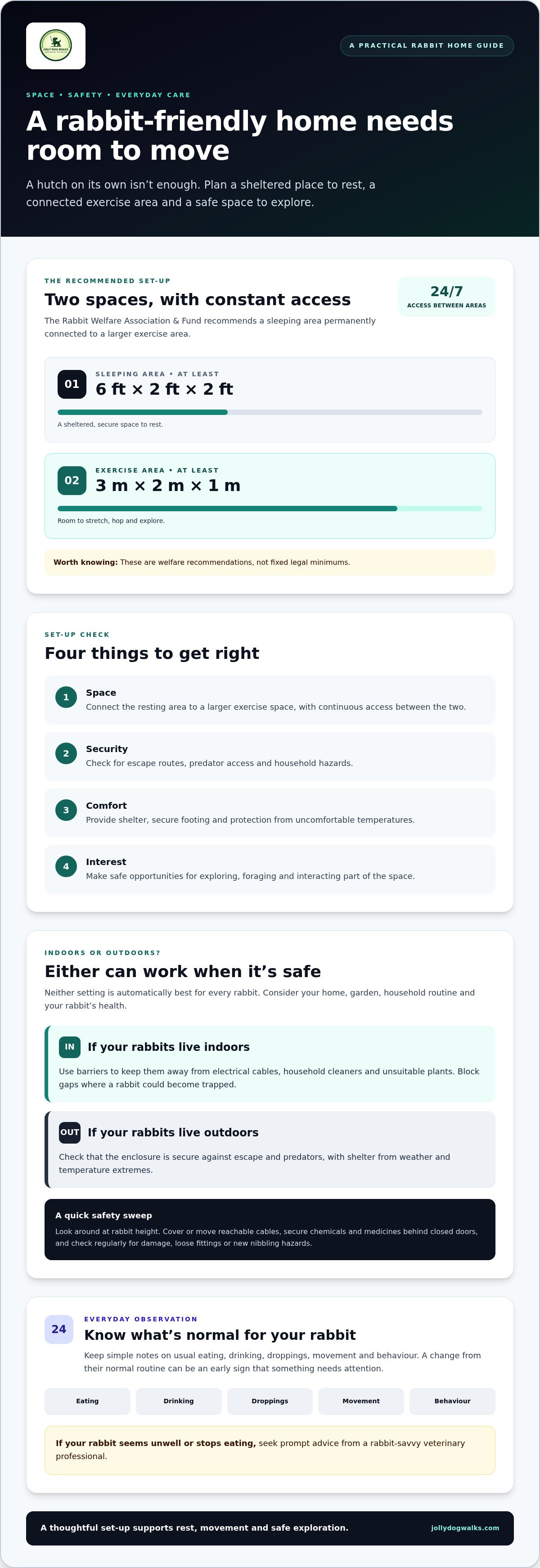
A rabbit-friendly home gives your rabbits a secure, comfortable place to rest and enough room to stretch, hop and explore. A traditional small hutch on its own won’t provide that. The Rabbit Welfare Association & Fund recommends a sleeping area of at least 6ft x 2ft x 2ft, permanently connected to an exercise area of at least 3m x 2m x 1m, with constant access between the two. These are welfare recommendations, not fixed legal minimums.
Plan the setup as a whole: sheltered resting space, suitable flooring, room to exercise and things to investigate. Before choosing an indoor or outdoor arrangement, consider your home, garden, household routine and the rabbit’s health. The Rabbit Welfare Association & Fund offers UK-focused guidance on housing and welfare needs.
What makes an indoor or outdoor space suitable?
Either setting can work if it’s safe and comfortable; neither is automatically best for every rabbit. Indoors, use barriers to limit access to hazards such as electrical cables, household cleaners and unsuitable plants. Outdoors, check that the enclosure is secure against escape and predators, and provides shelter from weather and temperature extremes. Ask a veterinary professional for advice tailored to your rabbit’s health.
How can you make the space safer?
Get down to rabbit height and look around as if you’re a curious little explorer. Cover or move reachable cables, keep chemicals and medicines behind closed doors, and block gaps where a rabbit could become trapped. Choose stable resting areas and flooring that offers secure footing, not a slippery surface. Check regularly for damage, loose fittings or anything newly within nibbling range.
How can enrichment fit into the home routine?
Enrichment gives rabbits safe ways to explore, forage and interact, making their space more than somewhere to eat and sleep. Offer suitable toys or objects to investigate, and make feeding more engaging by encouraging natural foraging. Introduce items carefully and check that they’re safe and in good condition. Notice what each rabbit chooses to use. Individual preferences matter, and an ignored toy isn’t a personal insult.
Use this checklist when planning your setup:
- Space: Is the resting area connected to a larger exercise space with continuous access?
- Security: Have you addressed escape routes, predator access and household hazards?
- Comfort: Is there a sheltered place to rest, secure footing and protection from uncomfortable temperatures?
- Interest: Can your rabbits explore, forage and interact safely?
A labelled sketch of your home or garden can make gaps easier to spot. Mark the resting area, exercise space, shelter, hazards to block and enrichment. For pet care for rabbits Staffordshire households can maintain, plan around the space and conditions at home, then adjust as your rabbits’ needs change.
What should rabbits eat, and what health changes should owners notice?
A rabbit’s diet should be based around good-quality hay or grass, with suitable fresh greens, an appropriate rabbit feed and constant access to clean drinking water. Hay is especially important because its fibre supports digestion and chewing. Choose greens and feed with guidance from a reputable UK rabbit-welfare source or your vet, as age, health and individual needs can affect what’s suitable. Welfare guidance discourages muesli-style mixes because rabbits may pick out preferred pieces rather than eat a balanced mix.
Keep an eye on the food bowl as well as what goes into it. Familiar foods make it easier to notice a change in appetite, and fresh water should always be available. For pet care for rabbits Staffordshire owners can manage confidently, keep a simple record of foods, feeding habits and known sensitivities. It’s useful for household members and anyone helping with care.
How can owners keep feeding consistent?
Write down the foods your rabbit usually eats, how they’re offered and anything they seem to avoid or react badly to. Include the type of feed and greens, rather than relying on memory when routines are shared. If you’re considering a change, seek appropriate veterinary or welfare advice and make it thoughtfully. Don’t assume a food that suits one rabbit will suit another.
Offer fresh greens known to be suitable for rabbits, and avoid introducing unfamiliar foods casually. If you’re unsure whether a particular plant or food is safe, check with a veterinary professional or a reputable UK rabbit-welfare organisation before offering it. This keeps feeding choices grounded in guidance relevant to pet rabbits in the UK.
Which changes should prompt a veterinary conversation?
Rabbits can be subtle about feeling unwell, so everyday observations are valuable. Notice whether your rabbit is eating and drinking as usual, and keep an eye on droppings, energy, movement and social behaviour. A brief note can help you describe what has changed and when it started. It isn’t a diagnosis, but it can give a vet useful context.
If your rabbit’s eating or behaviour changes noticeably, contact a veterinary professional for advice rather than waiting to see if it passes. A marked reduction in eating, no interest in food, unusual droppings or a rabbit who seems withdrawn all deserve attention. If you’re worried, call your veterinary practice promptly and explain what you’ve observed. This guide can help you keep useful records, but it can’t replace an assessment tailored to your rabbit.
How can you compare rabbit-care arrangements before choosing one?
Start with your rabbit, not the arrangement. Consider how easily their normal routine can continue, what level of supervision they need, and whether they’re likely to feel more settled at home or in another suitable environment. There isn’t one option that suits every rabbit or household. A written care profile helps whoever is looking after them follow familiar habits and understand what matters to you.
Use this comparison as a planning prompt, not a recommendation. The details depend on your rabbit, the arrangement and the length of your time away.
| Consideration | Care in your rabbit’s home | Care in another setting |
|---|---|---|
| Routine continuity | Familiar surroundings may make it easier to keep the usual layout and habits. | Agree how familiar foods, routines and companionship will be maintained in the new setting. |
| Supervision | Plan how feeding, water, cleaning and observation will fit into the care arrangement. | Clarify how your rabbit’s day-to-day needs and individual instructions will be followed. |
| Environment | Prepare the existing space and make essential instructions easy to find. | Consider how the new environment will accommodate your rabbit’s familiar needs and belongings. |
| Owner preferences | This may suit owners who prefer their rabbit to remain at home. | This may suit owners whose plans or household arrangements make another setting more practical. |
What should a rabbit care profile include?
Keep it clear and practical, so someone can follow it without guessing. Include:
- Usual feeding routine, familiar foods and known sensitivities.
- Normal behaviour and habits, including how your rabbit responds to handling.
- Relevant health information, medicines and instructions already provided by your vet.
- Home details, such as where supplies are kept and how to secure the rabbit’s space.
- Your preferred emergency contact process and the details of your veterinary practice.
A profile supports consistent care, but it can’t replace veterinary advice or guarantee an outcome. Keep it current, and make sure the person caring for your rabbit knows where to find it.
How can Staffordshire owners plan for time away?
For pet care for rabbits Staffordshire households can plan with confidence, start early enough to organise the practical details. Choose an arrangement that can support your rabbit’s established routine and the realities of your home and travel plans. Before you leave, set out written instructions and familiar, suitable supplies, and make key information easy to access. A short handover can explain your rabbit’s normal habits and where everything is kept.
If your household also has a dog whose routine needs planning while you’re away, Jolly Dog Walks offers dog-walking support. Rabbit care needs its own arrangement.
How do you build a practical rabbit-care plan for your Staffordshire home?
A written plan turns good intentions into clear, repeatable care. It’s especially helpful if household members share tasks or someone else needs to follow your instructions while you’re away. Keep it easy to find, update it when something changes, and make it specific to your rabbit rather than relying on a generic schedule.
Build your plan in four steps:
- Map daily needs. Note what your rabbit needs access to, including suitable food, clean water, a clean living area, movement and enrichment. Record the usual order of tasks if that helps your household remember them.
- Prepare the space. Write down which areas your rabbit can use, how to secure them and where supplies are kept. Include practical details a helper might not know, such as which gate or door must stay closed.
- Record familiar routines. Describe usual foods, habits, handling preferences and normal behaviour. These notes help someone notice a meaningful difference instead of guessing what’s typical.
- Organise veterinary details. Keep your practice’s contact details, relevant health information and current veterinary instructions together. Include your preferred process for contacting you if a concern arises.
What should go into a simple daily care checklist?
Make a copy that’s quick to read and easy to share. Use the prompts below, then add details that fit your rabbit and any instructions from your veterinary professional. Avoid vague reminders such as “check everything”; clear tasks are easier for another person to follow.
- Food: familiar foods offered and any notes about appetite.
- Water: check access to clean drinking water.
- Cleanliness: note the usual cleaning tasks and supplies.
- Movement and enrichment: record access to the rabbit’s usual space and activities.
- Behaviour: note anything different from your rabbit’s normal habits.
- Contacts: list the veterinary practice and your preferred emergency contact process.
How can owners keep the plan useful over time?
Review it when your rabbit’s needs, household arrangements or usual routine change. Replace outdated instructions, check that supplies are where the notes say they are, and keep veterinary details with the current care information. In a Staffordshire household, practical details might include who is home to handle regular tasks and how care fits around work, school or travel.
A useful care plan reflects the individual rabbit, not a one-size-fits-all routine. There’s no need to make it elaborate: a clear page of instructions, kept somewhere accessible, can help everyone provide more consistent care. For information about Jolly Dog Walks’ dog-walking work, see our Barton-under-Needwood dog-walking information.
Make your next step a manageable one
You don’t need to perfect every detail in a day. Choose one practical step for this week, such as writing down a feeding note or checking that everyone at home knows where the care instructions are kept. Small, thoughtful changes make consistent care easier and help you notice when your rabbit needs extra attention.
Good pet care for rabbits Staffordshire owners can feel comfortable with grows from paying attention, adapting as circumstances change and seeking veterinary guidance when something concerns you. Your rabbit’s needs are individual, and your plan can grow with them.
Jolly Dog Walks provides dog-walking and pet-care services across Barton-under-Needwood, Drakelow, Staffordshire, Yoxall, Hamstall Ridware, Branston, Burton upon Trent, Tatenhill, Rosliston, Walton upon Trent, Tutbury, Stretton and East Staffordshire. These services are for dogs, so arrange rabbit care separately.
Frequently Asked Questions
Can rabbits live alone, or do they need a companion?
Rabbits are social and generally benefit from living with a compatible rabbit companion. Introductions should be gradual, as simply placing unfamiliar rabbits together can cause stress or conflict. Neutering and compatibility are important considerations, so ask a rabbit-savvy veterinary professional or welfare organisation for guidance. If your rabbit is currently alone, plan any change carefully rather than rushing to bring home a new companion.
What should rabbits eat every day?
Hay or grass should make up the main part of a rabbit’s diet, alongside suitable greens, appropriate rabbit feed and fresh water. Check that your rabbit is eating its usual foods, and avoid sudden changes unless advised by a veterinary professional. For practical pet care for rabbits Staffordshire owners can maintain, keep food notes with the care plan, including familiar types and known sensitivities.
How much space does a rabbit need at home?
Welfare guidance recommends a sleeping area of at least 6ft x 2ft x 2ft connected permanently to an exercise run of at least 3m x 2m x 1m. Rabbits should be able to reach their exercise space whenever they need it, rather than being let out only occasionally. Measure the complete setup before bringing rabbits home, and check that doors and access points don’t reduce usable space.
Can rabbits be left alone while their owners are away?
Rabbits need someone responsible for their care while you’re away. Arrange for a suitable person to maintain their normal routine, check their wellbeing and respond if something seems wrong. Leave clear written instructions, supplies and your veterinary practice’s details together. In Staffordshire, as anywhere, allow time to organise this before a trip rather than relying on a last-minute plan.
How can I tell if my rabbit needs veterinary attention?
Contact a veterinary professional if you notice a concerning change, particularly if your rabbit stops eating, produces noticeably different droppings or seems unusually quiet. Other changes, such as difficulty chewing or a wet chin, are also worth discussing with a vet. Don’t try to diagnose the cause yourself. Note what you’ve observed and when it began, then share those details when seeking advice.
Is it better to keep a rabbit indoors or outdoors?
Neither option is automatically best; the right choice depends on the rabbit and whether the environment can be kept secure, comfortable and suitable throughout the year. Indoor rabbits need protection from household hazards, while outdoor housing needs reliable shelter and protection from predators and weather. Think about temperature, ventilation and daily access to the rabbit’s full living space, and seek veterinary advice if health affects the choice.
If you have a dog as well as a rabbit and need help with your dog’s routine, contact Jolly Dog Walks about solo dog walks and pet-care visits.

Article by
Victoria Cartwright
Hi, I’m Victoria, the proud owner of Jolly Dog Walks 🐾🐶
With a background in nursing and healthcare, alongside my professional training with the Institute of Modern Dog Trainers, I bring a unique combination of care, communication and understanding to my work with dogs and their owners. After leaving my nursing career, I found my true passion in working with animals, and I’ve never looked back!
❤️🐾
Disclaimer
Disclaimer: The views and experiences shared in this blog are based on my personal and professional experiences. They are intended for general information and enjoyment and should not replace individual advice from a qualified veterinary professional or appropriately qualified canine behaviourist/trainer where necessary.


