

Your puppy doesn’t need to wait for group classes to start discovering the world. Puppy socialisation without group classes in Branston can begin with calm, positive experiences at home and in carefully chosen settings. The key socialisation period runs from 4 to 12 weeks, so those early weeks matter.
It’s understandable to be cautious before your puppy has completed their vaccinations. Puppy School recommends that puppies are vaccinated and cleared by a vet before attending classes. Let them build confidence at their own pace.
This guide explains when to begin, how to approach early experiences safely, and how to help your puppy feel more comfortable around people, other dogs and unfamiliar places. You’ll also find practical ideas for everyday socialisation without a class, from getting used to household sounds to watching the world go by calmly. Small, positive moments can add up, without turning every outing into a big adventure.
Key Takeaways
- Start building positive experiences early, during the key socialisation period from 4 to 12 weeks.
- Before vaccinations are complete, choose calm, controlled ways to introduce your puppy to the world rather than taking them into high-traffic dog areas.
- Keep new experiences brief and gentle, and let your puppy set the pace if they seem unsure.
- Help your puppy grow comfortable with everyday handling, household sounds and new surroundings through small, positive practice.
- Individual puppy visits can provide a practical way to support your puppy’s routine and confidence.
Safe socialisation before vaccinations are complete
Early socialisation can begin before a puppy joins a class. Choose calm, controlled experiences rather than busy dog settings, and let your puppy observe from a comfortable distance.
Private sessions compared with group classes
A one-to-one session gives your puppy room to notice new sights and sounds without several dogs nearby. A group class offers planned exposure to other puppies, but the environment may feel busy to a newcomer. In Branston, puppy visits offer one-to-one care. Whichever option you choose, look for patient handling, a calm approach and time for your puppy to settle.
Socialisation age and vaccination guidance
The socialisation period is between 4 and 12 weeks of age, so gentle introductions can begin early. Puppies should have received at least their first vaccination before attending puppy training classes. According to Puppy School, puppies should also be vaccinated and cleared by a vet before attending classes. Group classes should wait until the full set of vaccinations recommended by the vet is complete.
Your puppy doesn’t need to miss every experience while vaccinations are in progress. Start at home with everyday sounds, different surfaces and calm visitors. Let your puppy watch someone come in, then give them the choice to approach instead of having the visitor reach over them. Show children how to sit quietly, avoid chasing and let the puppy move away.
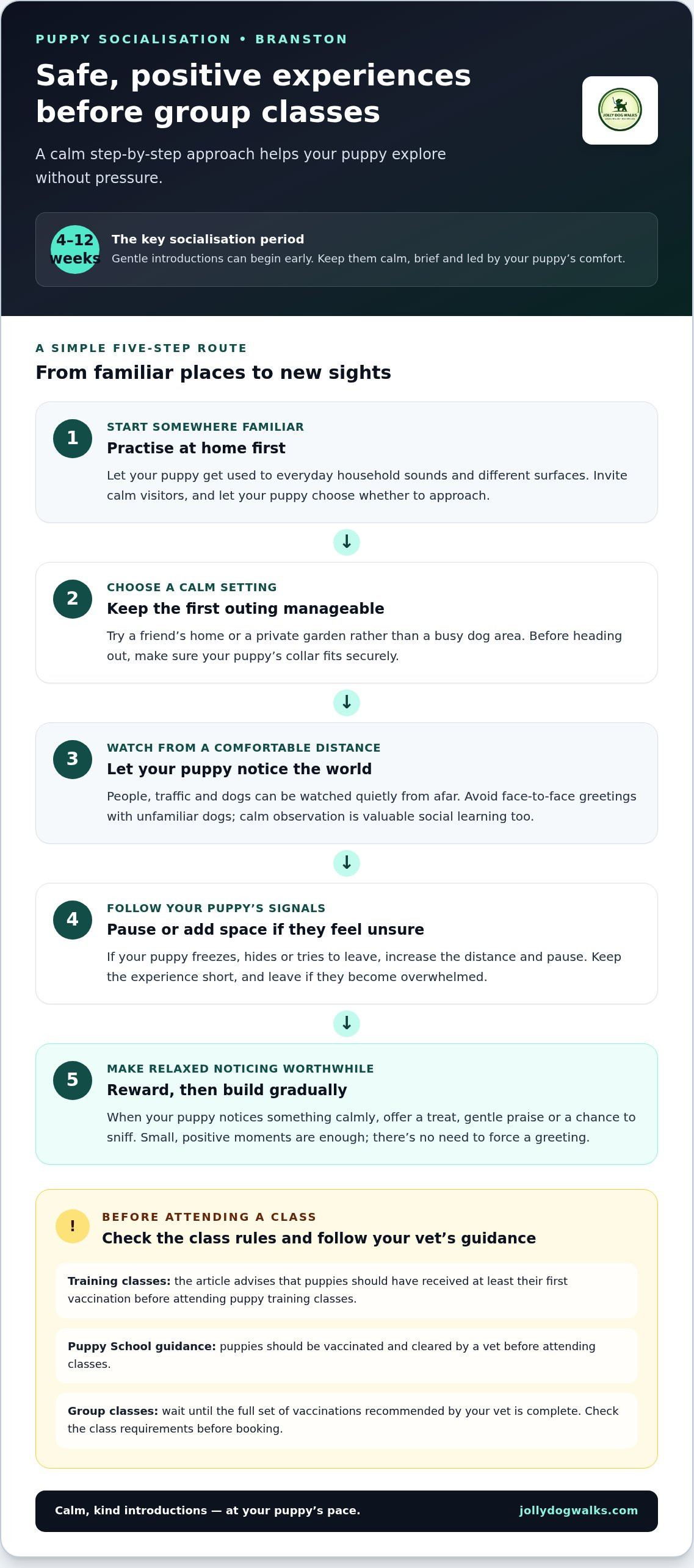
Use a step-by-step approach to keep outings manageable:
- Choose a quiet place, such as a friend’s home or a private garden.
- Let your puppy watch people, traffic or dogs from a distance, without forcing a greeting.
- Keep the experience short and leave if your puppy becomes overwhelmed.
- Reward relaxed noticing with a treat, gentle praise or a chance to sniff.
Before an outing, make sure your puppy’s collar fits securely and choose a quiet area. Avoid face-to-face greetings with unfamiliar dogs; watching calmly is valuable social learning too. If your puppy freezes, hides or tries to leave, increase the distance and pause. A positive experience lets them take in a new setting without pressure to interact.
Before booking a class, check its vaccination requirements and follow your vet’s guidance. Socialisation is about safe, positive exposure, not meeting every person or dog. Carefully chosen, calm experiences give your puppy space to learn at their own pace.
Key periods in puppy development
Puppies develop in stages, with different ways to explore and learn at each point. Broad milestones can help you choose suitable experiences, whether you’re practising at home or preparing your puppy for unfamiliar places.
During the first four weeks, puppies are usually with their mother and littermates in a warm place at the breeder’s. Their early changes happen quickly: puppies start to crawl at around 1 to 2 weeks old, and their eyes open at around 10 to 12 days. Ear canals open at around 14 to 16 days, as hearing develops.
By around 4 weeks, puppies can usually walk and begin exploring their surroundings. Everyday experiences at this stage are shaped by their early environment, including familiar smells, gentle handling and sounds around their sleeping area. Those first weeks aren’t a time for owners to arrange outings, but they help explain why a puppy’s early care matters.
Dog social development is often described in three periods: the primary period, the socialisation period and the enrichment or juvenile period. These aren’t rigid boxes. Each reflects a different part of development, and your puppy’s experiences, comfort and behaviour all matter when deciding what to introduce next.
The socialisation period starts at 4 weeks and runs between 4 and 12 weeks of age. During this time, introduce suitable sights, sounds, objects, people and animals in a calm way. For example, a puppy might investigate a cardboard box at home, or watch a visitor from a comfortable spot. Let the puppy approach, pause or move away.
Development doesn’t stop when that early period ends. Social learning continues into the juvenile period and adulthood, so keep offering positive experiences after 12 weeks. Familiarise your puppy with ordinary household sounds first; a recording or video of traffic can be played quietly, with the puppy free to leave. Increase the sound only when they remain relaxed.
Puberty is another milestone, not a signal to stop learning. Puppy School places puberty at around 6 months of age. As your puppy matures, keep practising familiar skills and introduce new situations gradually. A once-comfortable experience may feel different as they grow, so watch their body language rather than assuming earlier confidence will always carry over.
Note a new experience your puppy handles calmly, then build gradually from there. If a household sound startles them, lower the volume or increase the distance before trying again. Short, positive practice lets puppies explore at a manageable pace and helps you notice what feels comfortable.
Puppy age eligibility
A puppy’s age helps you choose suitable training, but it isn’t the only consideration. Puppies often go to their new homes between 8 and 12 weeks, so owners can begin gentle learning soon after arrival. Their comfort, vaccination stage and ability to settle also matter when deciding whether a class is suitable.
Puppy training classes don’t all use the same age window. The available guidance places class start ages at 10-20 weeks, while other puppy activities may have different cut-offs. Before booking, read the course’s age range alongside its vaccination requirements. That way, you can avoid choosing a class your puppy has already outgrown or isn’t yet eligible to attend.
Class age limits help organisers group puppies at similar developmental stages. A younger puppy may need more time to observe quietly, while an older one may already know basic cues. A class designed for younger puppies, for example, may not suit a dog beyond its stated age limit, even if they are still learning.
Use the age window as a starting point, then pay attention to how your puppy responds in new situations. Can they take treats, look around and recover after a surprising sound? If they hide or try to escape, the setting may be too much for now. A shorter, quieter introduction can help you gauge what feels manageable.
Compare classes by checking a few practical details:
- Age range: check the youngest and oldest ages accepted, including how the course defines age.
- Vaccination guidance: match the entry requirements to your puppy’s vaccination stage.
- Starting point: find out whether the course welcomes beginners or expects prior training.
- Room to settle: consider whether your puppy can observe without being pushed into contact.
If your puppy is too young for a class, you can still practise useful skills at home. Say their name and reward them for looking towards you, or introduce a new household object at a comfortable distance. Keep practice brief and stop while your puppy is engaged. A few treats can encourage them to investigate a cardboard box or unfamiliar mat.
After 12 weeks, keep offering positive experiences rather than treating that age as a deadline. Social learning continues as puppies grow, so practise familiar cues in new, calm settings. If age eligibility rules out a particular course, use the time to build foundations, note what your puppy enjoys, and choose a suitable next step when they’re ready to attend.
Confidence building and handling
Positive handling helps puppies learn that gentle touch can be predictable and safe. Keep sessions brief, reward relaxed behaviour and pause whenever your puppy needs space.
Building confidence through handling
Start with a step your puppy already accepts, such as briefly touching their shoulder, then offer a treat. Over several short sessions, gradually practise touching paws, ears and collar, without holding your puppy still. Gentle handling-based early stimulation is described during the first 10 days of life; once puppies are home, owners can continue gently, following their comfort rather than forcing contact.
Let your puppy investigate a harness before putting it on, and reward a calm sniff. Build up to wearing it around the house, and remove it if your puppy seems uncomfortable. Practise in short steps, offering a treat after each easy one. This helps make wearing a harness feel familiar rather than stressful.
Recognising comfort and overwhelm
A comfortable puppy may have a loose body, explore or accept treats. An overwhelmed puppy may turn away, hide, freeze, pant or repeatedly try to leave. Watch their overall behaviour, and make the experience easier if they stop engaging or seek distance.
Let your puppy’s response guide what you do next. If they accept a paw touch, reward them and finish there; try another gentle touch in a later session. If they pull away, stop and give them space. Pausing helps protect trust and prevents routine care, such as checking a paw, from becoming unpleasant.
For confidence-building practice, try these steps:
- Choose a quiet moment, rather than handling your puppy during an exciting play session.
- Touch one area briefly, then reward calm behaviour with a small treat.
- Keep the next step familiar, such as touching a shoulder before reaching for a paw.
- End the session while your puppy is still relaxed and willing to stay nearby.
Make a brief note of what your puppy accepts, such as a collar touch or gentle ear check. If they become uneasy, return to an easier step next time. Puppies learn at different paces, so build confidence through repeated positive experiences rather than trying to complete every handling task in one sitting. Gentle practice also helps you notice changes in their comfort.
Consistency matters as much as the handling step. Puppy School advises owners to practise for a few minutes many times each day, keeping each repetition manageable and ending before the puppy becomes unsettled. The aim isn’t to rush through a checklist, but to make small, familiar interactions part of everyday care.
One study found that puppies who were handled frequently and attended socialisation classes were less likely to be surrendered to a shelter as adults. This supports pairing calm handling with positive opportunities to experience the world. For harness practice, introduce it gradually at home and watch for signs that your puppy needs a break.
Meeting people, dogs and new places
Near Branston, practise calm introductions with a familiar dog and owner, or explore quiet public routes together. Free everyday outings can include a peaceful pavement, a quiet street or watching people pass from a comfortable distance.
Socialisation walks and controlled meet-ups
A socialisation walk doesn’t require puppies to greet or walk alongside each other. Arrange a calm parallel walk with a trusted owner and a relaxed dog, leaving space for both dogs to sniff and observe. Watch your puppy’s body language and increase the distance if they stop taking treats or try to move away. These steps help keep the introduction controlled.
For a meet-up, start with the dogs at a distance and let them approach only if both seem comfortable. Keep leads loose where safe, avoid nose-to-nose crowding and finish on a positive note. Classes offer structured practice, but a quiet meeting with a familiar dog can also help your puppy become comfortable around other dogs.
Local places and everyday outings
For everyday practice near Branston, try a quiet street, a pavement beside a green space or a calm spot where people pass. Choose somewhere with room to step aside, and avoid busy routes when your puppy needs a gentler introduction. Keep the outing brief enough for them to stay interested.
At around 8 weeks, a puppy may be newly settled into your home. Start with a low-pressure outing: pause at a quiet entrance, let them watch bicycles or passing people, then head home while they’re still comfortable. You don’t need to cover a long route; one new sight or sound can be plenty for that visit.
Try these simple exercises on different days:
- Stand at a quiet distance from a person, then reward your puppy for calmly noticing them.
- Let your puppy watch a dog walking past without approaching or being approached.
- Pause near a gate or open space and allow time to sniff before moving on.
- Change the setting gradually, such as moving from a quiet street to a calmer green-space edge.
Choose places where your puppy has space and you can leave easily. A busy path may suit them later but feel overwhelming during an early outing. If they look worried, turn away or stop engaging, create distance and let them settle before deciding whether to continue.
Focus on positive experiences, not a target number of people or dogs to meet. Walking calmly near another dog, briefly watching traffic or pausing outdoors can all be useful learning. Choose one manageable outing, bring treats and let your puppy’s comfort guide the next step.
Jolly Dog Walks: 10-40 minute solo dog walks
Jolly Dog Walks offers puppy visits and 10-40 minute solo dog walks, giving your puppy individual attention rather than a busy group setting. These can support a familiar routine and calm experiences as your puppy grows more comfortable with the world. Jolly Dog Walks takes a caring, welfare-focused approach, informed by IMDT training.
If your puppy needs gentle care at home, puppy visits can provide a check-in. Solo walks may suit a puppy ready to explore at a manageable pace. Keep socialisation gradual and build on positive experiences at your puppy’s comfort level.
To discuss puppy care in Branston, contact Jolly Dog Walks about a puppy visit or solo walk.
Make the next small step count
For puppy socialisation without group classes in Branston, choose experiences suited to your puppy today and build gradually. A quiet pause to watch the world, a visit from someone familiar or a relaxed walk can become part of a steady routine. Let your puppy’s response guide what comes next.
If a little practical support would help, Jolly Dog Walks offers Puppy visits, 10-40 minute solo dog walks and 60 Minute Solo Walks. These options give you a way to include care and individual attention in your puppy’s routine, alongside the positive experiences you’re building together.
Every puppy has their own pace, so there’s no need to rush. Choose one manageable next step, keep it gentle and celebrate small wins, even if today’s brave achievement is investigating a new doorstep.
Contact Jolly Dog Walks today to talk about support for your puppy.
Frequently Asked Questions
How can I socialise a puppy safely at home without group classes?
Use everyday household routines as gentle learning opportunities. Let your puppy investigate a new mat, hear the kettle from another room or watch you open an umbrella from a comfortable distance. Pair each experience with a treat or calm praise, and let them move away if they choose. For puppy socialisation without group classes in Branston, a small daily routine can add variety without overwhelming your puppy at home.
How can I introduce a puppy to people, children, dogs, traffic and household noises step by step?
Introduce one kind of experience at a time, starting with a quiet version. Ask an adult visitor to ignore your puppy at first; children can sit calmly and let the puppy choose whether to approach. When introducing dogs or traffic, begin at a distance where your puppy can watch without being pulled closer. Keep household sounds low, such as a softly played recording, and make the next exposure easier if your puppy seems unsettled.
What are the risks of puppy socialisation before full vaccination, and how can they be reduced?
The main concern is exposure to infectious disease before your puppy has completed the vaccinations recommended by their vet. Avoid busy dog areas and contact with unfamiliar dogs; choose clean, controlled experiences that don’t involve shared ground or equipment. Puppies should have at least their first vaccination before attending training classes, and Puppy School advises vaccination and veterinary clearance before class attendance. Wait until your puppy has completed their vet-recommended course before joining group classes.
Article by
Victoria Cartwright
Hi, I’m Victoria, the proud owner of Jolly Dog Walks 🐾🐶
With a background in nursing and healthcare, alongside my professional training with the Institute of Modern Dog Trainers, I bring a unique combination of care, communication and understanding to my work with dogs and their owners. After leaving my nursing career, I found my true passion in working with animals, and I’ve never looked back!
❤️🐾
Disclaimer
Disclaimer: The views and experiences shared in this blog are based on my personal and professional experiences. They are intended for general information and enjoyment and should not replace individual advice from a qualified veterinary professional or appropriately qualified canine behaviourist/trainer where necessary.


