
What if fewer indoor accidents start with offering toilet breaks before they feel urgent, rather than watching your puppy every second? If you’re searching for puppy toilet breaks Staffordshire, you may already know how unpredictable those first weeks can feel. You’re not alone, and an accident doesn’t mean your puppy isn’t learning.
A calm, consistent routine gives your puppy regular chances to get it right. This guide explains how to spot possible signs they need to go, when to offer a break and how to respond if an accident happens. It also covers practical ways to keep track of patterns and when daytime help, such as a puppy visit, may be worth discussing.
Every puppy is different, so progress can come in fits and starts. Watch what works for your puppy, keep expectations realistic and adjust the routine as needed. If their toileting changes suddenly or you’re worried about their health, contact your vet for advice.
Key Takeaways
- Build a toilet-break routine around your puppy’s patterns, offering regular opportunities rather than relying on them to signal every time.
- Sniffing, circling or wandering away may be clues your puppy needs to go, but look for their individual signs and context.
- Treat indoor accidents as useful information. Clean up calmly and return to the routine without punishment.
- Notice what your puppy was doing before successful toilet breaks to plan opportunities around waking, meals and play.
- This guide to puppy toilet breaks Staffordshire also explains when puppy visits from Jolly Dog Walks may help support a daytime routine.
Puppy toilet breaks in Staffordshire: what a realistic routine looks like
Toilet training takes patience, and there isn’t one timetable that suits every puppy. One may settle into a pattern quickly, while another has unexpected puddles along the way. That doesn’t mean you’re failing. For puppy toilet breaks Staffordshire owners can fit into everyday life, focus on regular opportunities and close observation rather than expecting an accident-free routine.
A calm, consistent toilet-break routine means offering regular chances to go, watching for your puppy’s individual patterns and responding patiently. Predictable opportunities make it easier to notice when your puppy is most likely to need the toilet and adjust your day. A routine can support learning, but it can’t guarantee there will be no accidents.
What counts as a toilet break for a puppy?
A toilet break is an opportunity to use a suitable place, not a promise that your puppy will go as soon as you step outside. Choose an area that’s easy to reach and, where practical, take the same route to the same spot. Keep things quiet and give your puppy time to sniff and settle. If nothing happens, head back in calmly, supervise them and offer another opportunity when it seems appropriate.
Consistency helps make the routine easier for both of you. For a straightforward overview of the principles behind a realistic routine, see the general guidance on housebreaking, which discusses patience and consistency.
Why puppies need individual routines
Your puppy’s day gives you useful clues. Waking, meals and play can all help you identify when to offer a break, while changes in the household or surroundings may affect what you observe. Rather than copying a rigid timetable, notice what happens before and after successful toilet breaks. A short note on your phone can help you spot patterns without making puppy care feel like a research project.
For example, you might notice your puppy often needs to go soon after waking, or that energetic play is followed by sniffing and moving away. Treat these as clues, not rules. Your puppy may respond differently from one day to the next. If their toileting habits change noticeably or you’re worried about their health, contact your vet for advice.
If you’re preparing for the wider responsibilities of puppy care at home, Jolly Dog Walks’ puppy-care home-visit checklist offers a useful next read.
Read puppy toilet cues and build a Staffordshire home routine
Your puppy may not yet have a reliable way to ask to go, so learning their small signals can help you offer a timely opportunity. Sniffing the floor, circling, wandering away from the family or suddenly pausing play may all be clues. None is certain on its own, though. A puppy might sniff because something smells interesting, not because they’re looking for a toilet spot.
Observing your puppy’s patterns is more useful than assuming every puppy follows the same schedule. For a while, note when they eat, sleep and play, when you offer a break, and whether they toilet or have an accident. This can reveal useful links, such as a pause in play often coming before a successful break. The RSPCA’s positive, practical guide can help you respond calmly and spot patterns as your puppy learns.
Which puppy behaviours may signal a toilet break?
Look for changes in what your puppy was just doing. They might start nosing around, turn in a small circle, move towards a door or become briefly restless. A sudden pause in play is also worth noticing, particularly if it’s followed by sniffing or moving away. These are prompts to offer a break, not proof that your puppy needs to go.
If you spot a possible cue, calmly guide your puppy to their chosen toilet area. Keep your movements gentle and your voice relaxed. If they don’t go, avoid making a fuss. Return indoors, supervise them and offer another chance if their behaviour suggests it may be needed.
How to make the toilet area easier to use
Choose a place that’s easy for you and your puppy to reach, and use the same route where practical. In a Staffordshire home, think through the path from the room where your puppy naps to the garden door. If there are stairs, a long hallway or several doors, plan how to get outside promptly and calmly.
Keep the area low-pressure. Give your puppy space to sniff without startling them or turning the break into a game. If the garden is busy or distracting, a quieter corner may help them settle. The aim is a familiar, manageable opportunity, not a performance on demand.
If you’re in or near Barton-under-Needwood and would like to explore local dog-care support, you can find out more about dog care in Barton-under-Needwood. When arranging care, explain your puppy’s usual bathroom routine and preferred location so the person looking after them knows what’s familiar.
Puppy accidents are not disobedience: respond calmly and spot patterns
An indoor accident isn’t proof your puppy is being naughty. They’re still learning where to go and may not yet be able to wait or let you know in time. Treat the moment as information: perhaps they needed another opportunity, or something in the routine or surroundings changed.
Punishment can add stress without teaching your puppy where you’d like them to toilet. Scolding, frightening them or rubbing their nose in the mess won’t help them understand what to do next. A calm response lets you focus on the useful next step.
What should I do after an indoor accident?
If you find a puddle, clean it up without making a fuss. Use a suitable household cleaner according to its instructions and keep your puppy away from the area until it’s ready for them. There’s no need to take them to the mess or tell them off. A later reprimand is unlikely to help them understand where they should have gone.
Then consider what happened beforehand. Had your puppy just woken, finished playing or been waiting longer than usual? Was there a change in the day, or did you miss a cue? You don’t need to solve a mystery every time, but noticing possible patterns can help you adjust the next opportunity.
Return to your usual routine and offer a suitable toilet break. If your puppy goes in the chosen place, offer calm praise straight afterwards. Keep the response simple and positive, so toileting in that place becomes a more rewarding experience without turning an accident into a frightening event.
When might accidents need extra attention?
Notice whether accidents are occasional, becoming a recurring pattern or appearing alongside another change in your puppy. A disrupted routine or a missed opportunity may be relevant, but an accident alone doesn’t tell you what caused it.
If your puppy’s toileting changes suddenly, the accidents persist or you’re concerned about their health, speak to your veterinary surgeon. They can advise whether your puppy needs an examination. Don’t assume a change is simply a training setback, and avoid trying to diagnose it yourself.
For owners working on puppy toilet breaks Staffordshire routines, progress may not be perfectly smooth. Clean up calmly, consider what came before and offer the next opportunity. This gives your puppy steady support without expecting an overnight fix.
Plan puppy toilet breaks around meals, sleep, play and time away
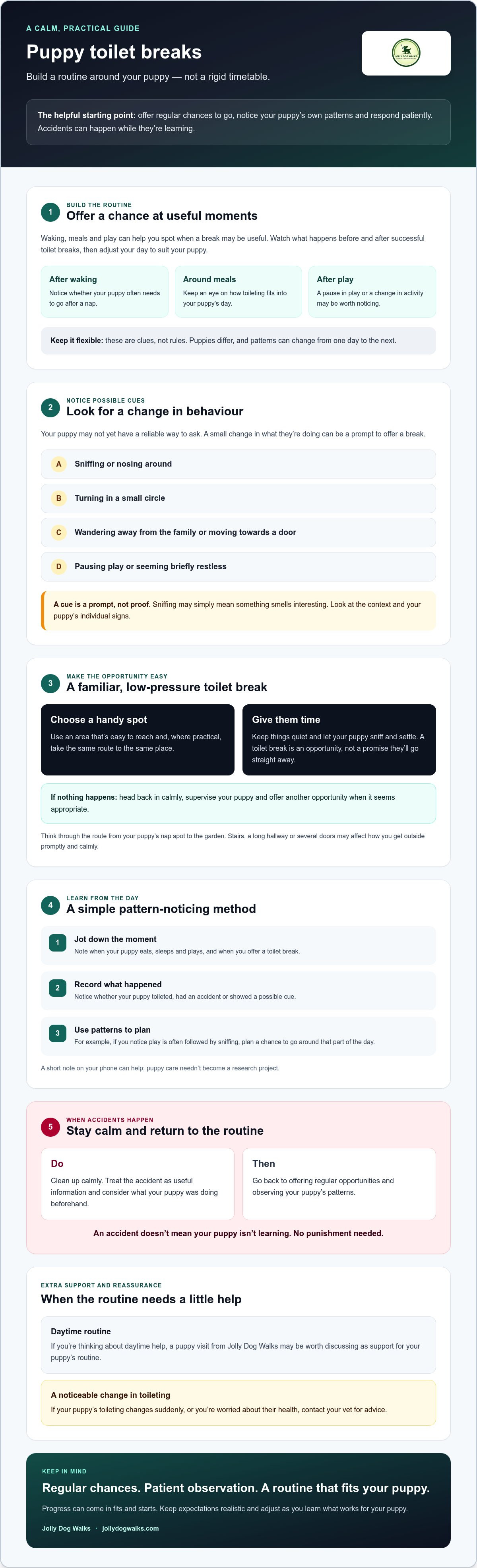
Use your puppy’s daily activities as prompts rather than watching the clock alone. Waking, eating and energetic play can all be good moments to offer another toilet opportunity. The aim isn’t to follow a perfect timetable, but to notice what suits your puppy and respond before they’re caught short.
A flexible routine for a typical day
Keep the steps simple, especially if other people share puppy care:
- Notice: Your puppy wakes, finishes a meal or pauses after play.
- Offer: Take them calmly to their usual toilet area.
- Wait: Give them time without rushing or distracting them.
- Record: Note whether they went and anything useful about the timing or circumstances.
This sequence isn’t a universal schedule or a guarantee against accidents. Use your notes to adapt: perhaps your puppy tends to need a chance after a certain activity, or a change in the household routine means you need to offer opportunities differently. Share the same simple approach with everyone who helps care for them, so your puppy has a more predictable experience.
What if you cannot be home for every break?
If work or other commitments take you away, plan suitable support around your puppy’s needs rather than expecting them to manage without a toilet opportunity. A trusted person who understands your routine may be able to help. Explain how to reach the chosen toilet area, what your puppy is familiar with and what signs they may show.
A puppy visit may also be worth exploring for daytime routine support. Jolly Dog Walks offers dedicated puppy visits. Discuss your puppy’s routine and preferred toilet location with the business, and check the current availability and precise scope of visits before making plans. Owners in the local area can find more information on the Barton-under-Needwood dog-walking and pet-care page.
Building puppy toilet breaks Staffordshire households can keep up with means making the plan realistic for both puppy and people. If you’d like to ask about puppy visits, contact Jolly Dog Walks to discuss your puppy’s routine.
When puppy toilet breaks need extra support in Staffordshire
Keeping up with a puppy’s daytime routine can be tricky if work, appointments or other commitments take you away from home. Extra help may be useful when your puppy needs an opportunity while you’re out, or when the usual routine is difficult to manage alone. The aim is to arrange suitable care that fits your puppy and household, rather than expecting them to cope without support.
Jolly Dog Walks offers dedicated puppy visits and local pet care across Staffordshire, including Barton-under-Needwood, Drakelow, Yoxall, Hamstall Ridware, Branston, Burton upon Trent, Tatenhill, Rosliston, Walton-on-Trent, Tutbury and Stretton, as well as surrounding areas in East Staffordshire. Ask the business about current availability and the precise scope of a puppy visit. A visit may support a daytime routine, but it should not be treated as a toilet-training guarantee or uninterrupted supervision.
What information helps someone caring for your puppy?
Clear, practical details help someone understand what’s familiar for your puppy. When arranging care, share:
- Your puppy’s observed bathroom routine and preferred toilet location.
- Relevant medical or behavioural information and emergency contact details.
- How to access the home or garden, and any areas your puppy must not enter.
Explain any changes to your puppy’s habits too, so the person caring for them has current information. Simple instructions, such as which door leads to the garden, can make the visit clearer for everyone.
How to explore puppy visits around Burton and nearby areas
If you live in Burton upon Trent or elsewhere nearby, explain when you need support and what your puppy is used to. Ask Jolly Dog Walks about the visit arrangements, current availability in your area and what the service can include. That will help you decide whether the support suits your puppy and household before making plans.
Share your puppy’s preferred toilet area, relevant care needs and agreed home-access instructions. Keep expectations realistic: a visit may help support a daytime routine, while toilet training still takes patience and varies from puppy to puppy.
If you’d like to find out whether this support could suit your household, ask Jolly Dog Walks about puppy visits.
Build a routine that grows with your puppy
Good toilet habits develop through regular opportunities, patient observation and a calm response when accidents happen. Watch for your puppy’s individual cues, and use everyday moments such as waking, meals and play to shape a flexible routine. If their toileting changes suddenly or you’re concerned about their health, speak with your veterinary surgeon.
Every puppy learns at their own pace, so don’t be disheartened by the occasional puddle. Brief notes can help you spot patterns and adjust your approach as your puppy grows. That’s the heart of puppy toilet breaks Staffordshire owners can build on: consistency, kindness and realistic expectations.
Jolly Dog Walks offers dedicated puppy visits. If daytime support might suit your household, ask Jolly Dog Walks about puppy visits and check the current arrangements.
With patience and a plan that works for your home, you and your puppy can keep making steady progress, one break at a time.
Frequently Asked Questions
How often should I take my puppy out for a toilet break?
Offer regular toilet opportunities, particularly after your puppy wakes, eats or has been playing, and when you notice possible cues. The right rhythm depends on your puppy’s age, habits and what you observe, so a rigid timetable may not suit them. Keep brief notes about breaks and outcomes, then adjust your routine as you notice patterns. If you’re unsure what’s appropriate for your puppy, ask your veterinary surgeon for advice.
What signs show that my puppy needs to go outside?
Sniffing the floor, circling, wandering away or becoming restless can be clues, but none is certain on its own. A sudden pause in play may also be worth noticing, especially if your puppy starts sniffing or heads towards a door. If you spot a possible cue, calmly guide them to their usual toilet area and give them time. Watching what happens before successful breaks can help you recognise your puppy’s individual signals.
What should I do if my puppy has an accident indoors?
Stay calm, clean the area thoroughly and return to your usual routine. Think about what happened beforehand: perhaps your puppy had just woken, finished playing or needed a break sooner than expected. Offer another suitable opportunity and praise them calmly if they toilet in the chosen place. An accident is information, not proof your puppy is being naughty, so focus on what might help next time rather than blame.
Should I tell my puppy off for toileting in the house?
No. Scolding, frightening your puppy or rubbing their nose in the mess can cause stress without showing them where you’d like them to toilet. If you catch them in the act, calmly guide them to the right area if you can do so without startling them. If you find the accident later, simply clean it up. Calmly rewarding toileting in the chosen place gives your puppy a clearer lesson.
How can I manage puppy toilet breaks when I am at work?
Arrange reliable help so your puppy has suitable toilet opportunities while you’re away, rather than expecting them to manage without support. Share practical details, including your puppy’s usual cues, preferred toilet area and garden access. A simple record of meals, breaks and outcomes can help everyone follow a consistent approach. Plan around your puppy’s needs and the care you can reliably arrange, rather than relying on a one-size-fits-all timetable.
Can a puppy visit help with daytime toilet-break routines in Staffordshire?
A puppy visit may help support a daytime routine, but check current availability and arrangements directly with Jolly Dog Walks. The business offers dedicated puppy visits. Explain your puppy’s bathroom routine and preferred location when discussing care. Jolly Dog Walks serves Staffordshire, including Barton-under-Needwood and Burton upon Trent, as well as surrounding areas. A visit can support the routine, but it isn’t a guarantee of toilet-training results.
When should I ask a vet about my puppy’s toileting?
Contact your veterinary surgeon if your puppy’s toileting changes suddenly, the change persists or you’re concerned about their health. Your vet can assess your puppy and advise whether further attention is needed. Don’t assume a new or recurring problem is simply part of toilet training, and avoid trying to diagnose the cause yourself. If you’re worried, it’s sensible to seek professional advice rather than wait for the routine to resolve it.
Article by
Victoria Cartwright
Hi, I’m Victoria, the proud owner of Jolly Dog Walks 🐾🐶
With a background in nursing and healthcare, alongside my professional training with the Institute of Modern Dog Trainers, I bring a unique combination of care, communication and understanding to my work with dogs and their owners. After leaving my nursing career, I found my true passion in working with animals, and I’ve never looked back!
❤️🐾
Disclaimer
Disclaimer: The views and experiences shared in this blog are based on my personal and professional experiences. They are intended for general information and enjoyment and should not replace individual advice from a qualified veterinary professional or appropriately qualified canine behaviourist/trainer where necessary.


