
What if a puppy home visit could make the working day feel more manageable without pretending to solve every puppy worry? If you’re considering puppy home visits Staffordshire, it’s natural to wonder how a visit might fit around toilet breaks, meals and naps, and whether your young dog will still need your training and company. They will: a visit is practical support, not a stand-in for you.
Young puppies have little routines and big needs, so a familiar face at home can help break up a stretch alone and keep their day more predictable. The right approach depends on your puppy, their age and the routine you’re building together. It also helps to be clear about what you want the visit to support, whether that’s a toilet break, some company or keeping familiar parts of the day on track.
In this article, you’ll learn what a puppy visit can realistically offer, how to prepare simple instructions and familiar essentials, and how to think about visits alongside gradual alone-time practice. Jolly Dog Walks provides dedicated puppy visits across its local Staffordshire service area. The practical starting point is your puppy’s own routine, rather than a one-size-fits-all schedule.
Key Takeaways
- Puppy home visits Staffordshire can offer practical support while you’re away, with care taking place in your puppy’s familiar surroundings.
- Make visits fit your puppy’s individual day by sharing their usual toilet, meal, play and rest patterns.
- Leave clear notes about familiar cues, feeding and any care needs so your puppy’s routine is easier to follow.
- A home visit can help break up time alone, but it isn’t a replacement for training, companionship or continuous care.
- Jolly Dog Walks provides dedicated puppy visits in its local Staffordshire service area.
Puppy home visits in Staffordshire: what are they for?
A puppy home visit is planned care for a young dog in their own familiar home while their owner is away. The puppy stays at home, and the visit is centred on practical care rather than a structured training lesson. For owners juggling work, errands or other time away, it can provide support that fits around the puppy’s age, routine and individual needs.
Keeping care in familiar surroundings makes it easier to follow the patterns your puppy is already learning. Their bed, resting place and usual household sounds are part of their everyday world. Share what your puppy is comfortable with and how they tend to spend their day, so their care can be approached with thought and consistency.
A puppy’s environment matters too. This video offers a useful look at creating suitable space at home:
What can a home visit support during a puppy’s day?
A visit can be planned around what your puppy needs at that stage, rather than following a one-size-fits-all timetable. A very young puppy’s day may look quite different from that of an older pup. Let the carer know your puppy’s usual rhythm, favourite comforts and any relevant care needs. Familiar cues can help keep things consistent, while allowing for the fact that puppies have off days too.
Early experiences also matter as puppies grow. Their critical period of socialisation is a time for thoughtful, positive exposure to everyday experiences. A home visit isn’t a substitute for a wider socialisation plan, but sharing what your puppy is used to can help the carer respect their comfort and confidence. For example, explain whether your puppy is familiar with visitors, household noises or being handled, rather than assuming they’ll be comfortable with every new experience.
What a puppy home visit cannot promise
A visit can’t guarantee toilet-training progress or prevent every unsettled moment. Puppies are learning, and their needs can change as they grow. Accidents or a little uncertainty don’t mean anyone has failed; they’re useful information to consider when adapting the routine. A note of when accidents happen, for instance, may help you notice whether the timing of a toilet break needs adjusting.
Visits also don’t replace ongoing companionship, kind teaching or your involvement in your puppy’s life. Think of them as practical support during time away, not continuous supervision or a shortcut to training. Jolly Dog Walks provides dedicated puppy visits in its local Staffordshire service area, with care shaped around each puppy rather than a rigid formula.
How puppy home visits fit around rest, toilet breaks and routine
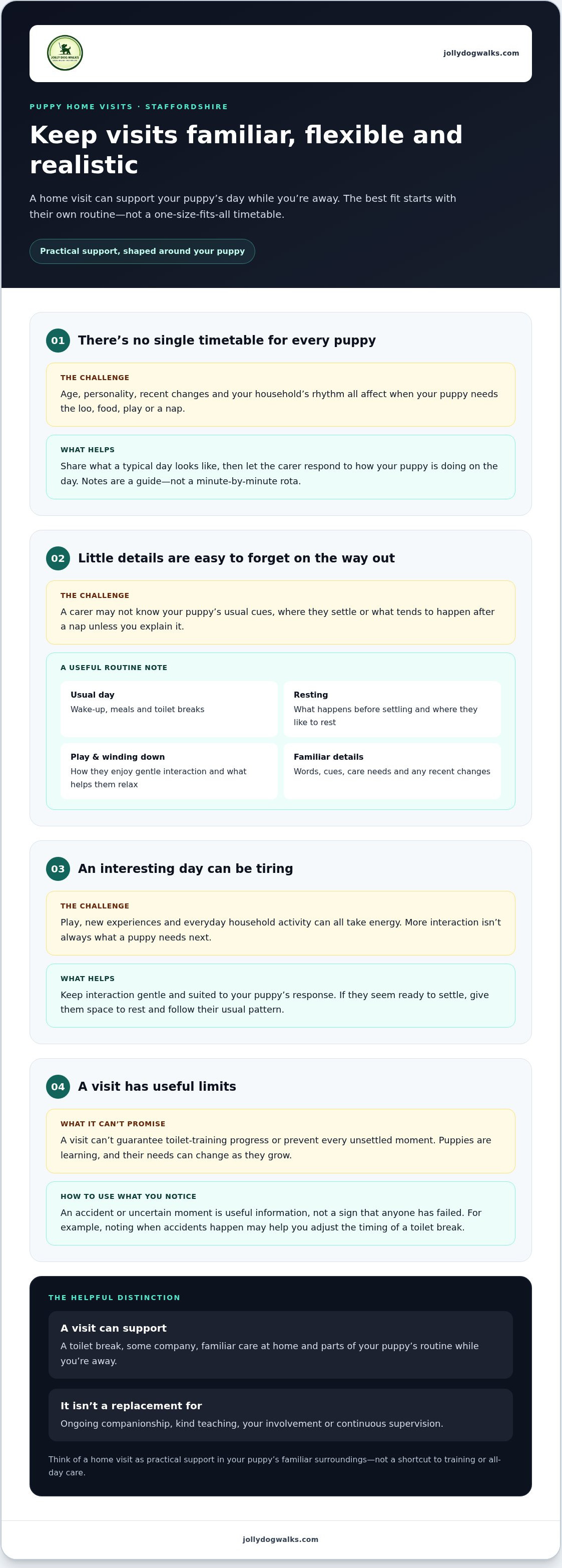
There isn’t one timetable that suits every puppy. Age, personality, recent changes and the rhythm of your household all affect when a puppy needs the loo, food, play or a nap. A helpful visit takes its cue from the puppy in front of the carer, rather than trying to squeeze every young dog into the same schedule.
Before care begins, jot down what a typical day looks like. Include the little details that can be easy to forget when you’re rushing out the door:
- When your puppy usually wakes, eats and goes outside for a toilet break.
- What they tend to do before settling, and where they like to rest.
- How they enjoy gentle play or interaction, and what helps them wind down.
- Any familiar words, cues or care needs you’d like the carer to know about.
These notes don’t need to be a minute-by-minute rota. They give a carer a useful picture of what’s familiar, while leaving room to respond to how your puppy is doing on the day. If something has changed recently, such as a different meal routine or a new place to rest, include that too. The RSPCA also offers guidance on how to establish a consistent routine as part of caring for a puppy.
Why familiar routines matter at home
Usual cues and spaces can make a visit feel more predictable: your puppy may recognise where they rest, where their food is kept and what normally happens after a nap. Tell the carer what your puppy tends to do before and after resting, as well as any preferences that help them feel at ease. Familiarity can support consistency, though it can’t guarantee there’ll be no accidents or unsettled moments.
Predictable routines can help puppies settle by making everyday events easier to anticipate. That doesn’t mean the day must run perfectly; puppies are still learning, and their needs can vary. If your puppy usually settles after a quiet period, for example, explain what that looks like so the carer can follow the familiar pattern.
Balancing activity with rest
Puppies need chances to rest between interesting things because play, new experiences and ordinary household activity can be tiring. Keep interaction gentle and suited to your puppy’s response. If they seem ready to settle, give them space to rest rather than assuming they need more play. There’s no need to impose a rigid exercise target: follow your puppy’s usual pattern and share any concerns about their care needs.
For owners considering puppy home visits Staffordshire, this kind of routine information is a simple way to help keep care individual and familiar. Jolly Dog Walks provides dedicated puppy visits in its local Staffordshire service area. You can explore puppy visits with Jolly Dog Walks as one option for support shaped around your puppy’s day.
Can puppy home visits replace training or all-day care?
A puppy home visit can offer useful support while you’re away, but it isn’t a substitute for either ongoing training or continuous care. Your puppy remains in familiar surroundings and receives attention during the planned visit, but there will still be time before and after it when their needs are yours to manage.
A visit provides practical care during a planned check-in; training is built through kind, consistent practice over time; all-day care means a person is present for a much longer stretch. Keeping those roles clear helps you choose support that suits your puppy and set realistic expectations.
Home visits compared with other kinds of support
Your everyday care is where much of your puppy’s learning happens: you get to know their signals, build familiar cues and practise skills in ordinary situations. A home visit can complement that care by helping maintain the routine while you’re out, rather than taking over your role or delivering a complete training programme.
Training isn’t a one-off event. Puppies learn at different rates, and progress comes from patient repetition and positive reinforcement in daily life. A carer can follow your familiar cues during a visit, but that doesn’t mean a skill will be fully learnt or reliable everywhere. For a broader foundation, the RSPCA puppy care guidelines offer advice on caring for and teaching a young dog.
Setting kind, realistic expectations
Some days your puppy may settle happily; on others, they may need more reassurance or have an accident. That’s part of caring for a young dog, not a promise that a visit can prevent every difficult moment. Notice what your puppy’s behaviour is communicating and share helpful changes with the person caring for them. Avoid expecting instant results, and keep practice calm, rewarding and suited to your puppy.
If toileting or behaviour changes concern you, or you suspect an underlying health issue, speak with your veterinary professional. A visit supports the practical routine; it can’t assess or treat medical problems.
Jolly Dog Walks’ dedicated puppy visits are intended as personal support for Staffordshire owners, not a replacement for the bond and everyday involvement you build with your puppy. If you’re weighing up what may fit around your routine, find out about puppy visits with Jolly Dog Walks.
How to prepare your home and puppy for a Staffordshire visit
A little preparation helps a carer follow the routine your puppy already knows. If you’re planning puppy home visits Staffordshire, these simple steps can make it easier to share useful details and create a familiar, safe space for your young dog.
Share the information that helps keep care familiar
Write down the essentials rather than relying on a quick chat at the door. Your notes can be brief, but should explain what a typical day looks like and what helps your puppy feel comfortable. Include:
- Usual toilet habits, meal times and where fresh water is kept.
- Where your puppy normally rests, and what they tend to do before and after a nap.
- Familiar words or cues, favourite ways to play, and anything they find worrying.
- Relevant health, behaviour or care information, including anything that has changed recently.
Be clear about food and any feeding instructions, too. A short written note can help prevent crossed wires and gives the carer something easy to refer to. Mention any allergies, medication or other care needs that are relevant, and make sure the details are current. For more ideas, see this professional puppy care checklist.
Make the home ready for a calm visit
Before care begins, take a quick look around from puppy height. Put away anything they could chew or swallow, and leave familiar essentials, such as their bed or a well-loved toy, where they normally belong. Explain which areas are safe for your puppy and which should stay out of bounds.
Give clear instructions for entering the home, including how to use the key or access arrangements and what to do on arrival. If anything about the home routine is unusual, make a note of it. That small detail could be as simple as a gate that needs to stay closed or a door your puppy tends to investigate. Clear instructions help avoid confusion and keep the visit focused on your puppy.
Keep the handover simple and personal
Every puppy is different, so share both the practical details and the little things you’ve noticed: perhaps your pup settles best after a quiet moment, or needs a gentle approach around a particular sound. Clear information helps the carer respond thoughtfully without expecting your puppy to behave in a set way.
Jolly Dog Walks provides dedicated puppy visits across its local Staffordshire service area. If you’re ready to arrange personal support that respects your puppy’s home routine, get in touch about puppy visits.
Puppy home visits from Jolly Dog Walks in Staffordshire
For puppy owners around Staffordshire, support at home can be a helpful way to make time away fit more comfortably around a young dog’s day. Jolly Dog Walks provides dedicated puppy visits in its local service area. The focus is personal care that respects each puppy’s familiar home and individual needs.
Local puppy care around Barton-under-Needwood and Burton
Jolly Dog Walks serves local communities including Barton-under-Needwood, Drakelow, Yoxall, Hamstall Ridware, Branston, Burton upon Trent, Tatenhill, Rosliston, Walton on Trent, Tutbury and Stretton, across East Staffordshire. If you’re nearby, you can explore dog walking and pet care in Barton-under-Needwood to learn more about support in the area.
A reassuring next step for puppy owners
Before deciding what support might suit, think about your puppy’s usual day and the moments you’re away. Are you most concerned about a toilet break, keeping familiar routines or breaking up a longer stretch alone? Having a clear picture of your puppy’s needs makes it easier to consider how a visit could fit into the wider care you provide.
There’s no single routine that works for every young dog. Some puppies are confident with familiar people and patterns; others need a gentler, more gradual approach. Sharing your puppy’s preferences, worries and everyday cues helps make care more individual, without expecting one visit to replace your companionship or ongoing involvement.
If you’re considering puppy home visits Staffordshire, Jolly Dog Walks offers a friendly local option for practical support at home. Explore the Barton-under-Needwood page for local care information, and take your time thinking through what would help your puppy feel comfortable. Thoughtful, consistent care starts with getting to know the individual puppy, one small paw-step at a time.
Find puppy support that fits your routine
A home visit can offer practical support in your puppy’s familiar surroundings, while keeping their own routine at the centre of care. Clear notes about toilet habits, meals, rest and familiar cues help make visits more personal. Just as importantly, a visit supports the care you provide; it doesn’t replace ongoing companionship or kind, consistent training.
If you’re considering puppy home visits Staffordshire, Jolly Dog Walks provides dedicated puppy visits across its local Staffordshire service area. The business serves communities including Barton-under-Needwood, Drakelow, Yoxall, Hamstall Ridware, Branston, Burton upon Trent, Tatenhill, Rosliston, Walton on Trent, Tutbury and Stretton.
Every puppy is an individual, so the best starting point is thinking about what your young dog needs during your time away and the routine that helps them feel at home. For a friendly next step, explore puppy care with Jolly Dog Walks. With thoughtful support and a familiar routine, you can help your puppy take those early days one paw-step at a time.
Frequently Asked Questions
What happens during a puppy home visit?
A puppy home visit is planned care in your puppy’s own home while you’re away. The carer follows the agreed routine and considers your puppy’s age, usual habits and individual needs. You can share notes about toilet breaks, food, rest, familiar cues and anything that helps your puppy feel settled. The visit offers practical support, rather than a guaranteed training session or continuous supervision.
Can a puppy home visit help with toilet training?
A visit can support the routine you’re building by giving your puppy a chance to go outside at an appropriate point in their day. Sharing their usual toilet habits and cues helps the carer follow familiar patterns. However, no visit can guarantee toilet-training progress or prevent accidents. Keep practising patiently at home, reward the behaviour you want to encourage, and speak to your vet if toileting changes worry you.
How often does a puppy need someone to visit at home?
There isn’t a single visit schedule that suits every puppy. Consider your puppy’s age, normal routine, toilet needs, time alone and how they cope when you’re away. A very young puppy may need more frequent support than an older one, but their individual habits matter too. Keep track of when they usually eat, rest and need the toilet, then use that information to plan suitable care.
Is a home visit better than leaving a puppy with a sitter?
It depends on your puppy and the kind of support you need. With a home visit, your puppy stays in familiar surroundings and receives planned care there. Other sitter arrangements may involve a different setting or a longer period of care. Think about your puppy’s comfort, routine and time away when weighing up options. A home visit can be a useful part of their care, but it isn’t continuous supervision.
Can puppy home visits replace training or companionship?
No. Puppy home visits offer practical support during an agreed visit, but training and companionship remain part of everyday life with you. Puppies learn through kind, consistent practice over time, and they each progress at their own pace. A carer may follow familiar cues, but one visit can’t promise a particular training result or replace the relationship and guidance you build with your puppy.
How should I prepare my home for a puppy visit?
Write down your puppy’s usual routine, feeding information, toilet habits, familiar words and any relevant health or behaviour needs. Leave their familiar resting essentials and fresh water in their usual place, and put potentially unsafe items out of reach. Give clear entry instructions, explain where your puppy can go and point out any restricted areas. Simple, practical notes help keep the visit familiar.
Do Jolly Dog Walks provide puppy home visits in Burton upon Trent and nearby areas?
Yes. Jolly Dog Walks provides dedicated puppy visits in Burton upon Trent, Barton-under-Needwood and surrounding Staffordshire areas, including nearby communities such as Branston, Tatenhill, Yoxall, Drakelow, Rosliston, Walton on Trent, Tutbury and Stretton. Care is shaped around each puppy’s routine and individual needs.
Article by
Victoria Cartwright
Hi, I’m Victoria, the proud owner of Jolly Dog Walks 🐾🐶
With a background in nursing and healthcare, alongside my professional training with the Institute of Modern Dog Trainers, I bring a unique combination of care, communication and understanding to my work with dogs and their owners. After leaving my nursing career, I found my true passion in working with animals, and I’ve never looked back!
❤️🐾
Disclaimer
Disclaimer: The views and experiences shared in this blog are based on my personal and professional experiences. They are intended for general information and enjoyment and should not replace individual advice from a qualified veterinary professional or appropriately qualified canine behaviourist/trainer where necessary.


